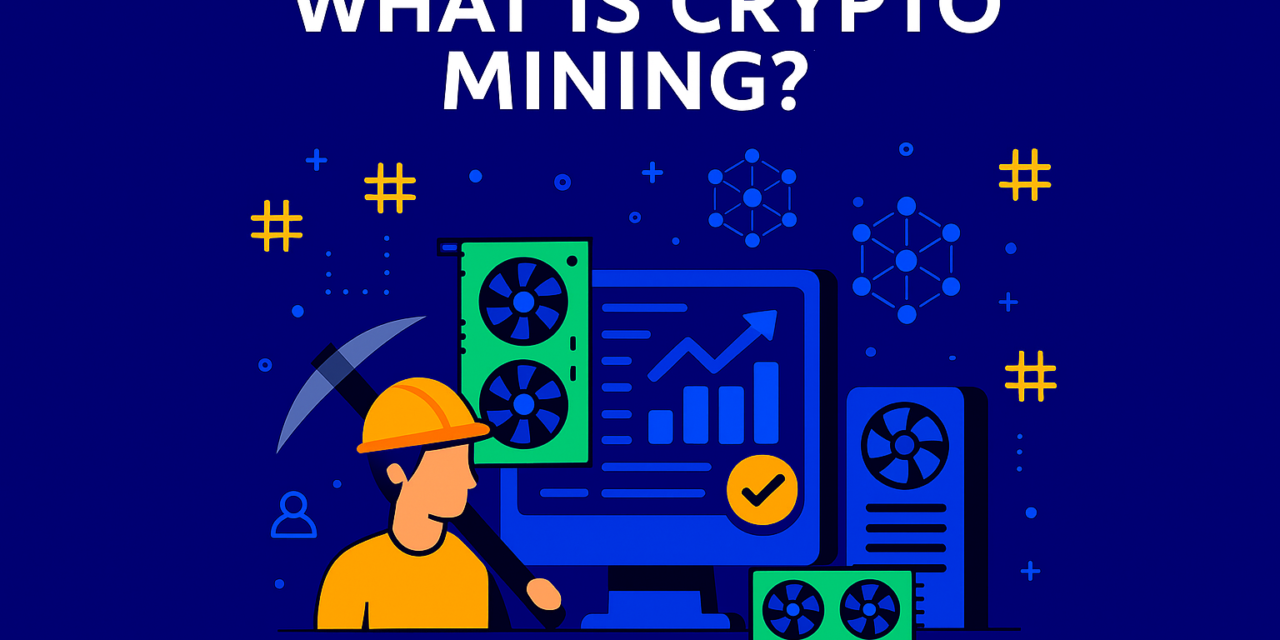
1. What Is Crypto Mining?
Crypto mining is the process of validating transactions and adding new blocks to a blockchain using computers. In return for doing this important work, miners earn cryptocurrency as a reward.
In simple words: Crypto mining is like digital bookkeeping but done using computers competing to solve complex math puzzles.
Mining ensures that:
- transactions are verified
- the network stays secure
- new coins enter circulation
This is how major cryptocurrencies like Bitcoin operate.
2. How Does Crypto Mining Work?
Most cryptocurrencies use a system called Proof of Work (PoW).
Here’s the easy explanation:
Step 1: A transaction happens
Someone sends crypto from one wallet to another.
Step 2: Miners check the transaction
Thousands of mining computers verify if it’s valid.
Step 3: Miners compete to solve a puzzle
This mathematical puzzle is extremely hard and requires high computing power.
Step 4: First miner to solve it wins
They add the new block of transactions to the blockchain.
Step 5: Miner receives a reward
This reward is how new coins are created.
For Bitcoin, as of 2026, miners receive:
- Block reward (BTC)
- Transaction fees
This is why mining is profitable if done correctly.
3. Why Does Crypto Need Mining?
Mining is important because it helps:
- Secure the network
The more miners participate, the harder it becomes for hackers to attack.
- Prevent double spending
Mining ensures no one can spend the same coin twice.
- Maintain decentralization
No single authority controls the system.
- Release new coins
Mining is how new cryptocurrency enters circulation.
Without mining, PoW cryptocurrencies would simply not function.
4. What Do You Need to Start Crypto Mining?
Mining isn’t something you can do casually on a laptop today. The competition is high, and profitable mining requires powerful hardware.
1. Mining Hardware
Depending on the coin:
ASIC miners (most powerful; used for Bitcoin)
GPU rigs (good for Ethereum‑Classic, Ravencoin, etc.)
2. Mining Software
Programs that connect your hardware to the blockchain.
3. Electricity
Mining consumes a lot of power. Electricity cost determines whether mining is profitable.
4. Mining Pool (optional but recommended)
Groups of miners who combine computing power and share rewards.
5. How Do Miners Earn Money?
Miners earn in two ways:
1. Block Rewards
When they successfully mine a block, they get a reward.
Example: Bitcoin miners receive BTC for each block mined.
2. Transaction Fees
Users pay small fees for sending coins. Those fees go to miners.
6. Is Crypto Mining Bad for the Environment?
Mining does use energy—but innovations are improving efficiency:
- renewable energy (solar, wind, hydro)
- energy‑efficient ASIC miners
- “green mining” projects globally
Many mining companies in 2026 claim over 60% of energy use from renewables, and the number keeps improving.
7. Proof of Work vs Proof of Stake (PoW vs PoS)
Some newer blockchains have moved away from mining.
Proof of Work (PoW)
- Uses mining
- More secure
- Requires heavy energy use
- Used by: Bitcoin, Litecoin, Dogecoin
Proof of Stake (PoS)
- No mining
- Users stake coins
- Low energy use
- Used by: Ethereum (after 2022 merge), Cardano, Solana
Mining is still important, but the industry is exploring greener options.
8. Is Crypto Mining Still Profitable in 2026?
Yes, but only in certain conditions.
Mining is profitable if:
- electricity cost is low
- equipment is efficient
- the mined cryptocurrency price is strong
- miners join pools instead of solo mining
Bitcoin mining profitability depends heavily on market conditions and halving cycles.
9. Pros and Cons of Crypto Mining
Pros
- Potentially profitable
- Supports the blockchain network
- Can be automated 24/7
- Can use renewable power for cost efficiency
Cons
- High electricity cost
- Requires expensive hardware
- Loud and hot equipment
- Mining difficulty increases over time
10. Future of Crypto Mining
The future of mining is evolving, with trends like:
- More efficient hardware
- Stronger focus on renewable energy
- Mining farms in cooler climates
- More institutional mining companies
- Shift toward hybrid systems combining PoW and PoS
Mining remains a crucial part of the crypto ecosystem, especially for Bitcoin, which will always rely on Proof of Work.
11. Final Thoughts
Crypto mining is the backbone of blockchain security.
It validates transactions, releases new coins, and keeps decentralized networks running securely.
While mining is no longer a simple “home computer” activity, it continues to be a key part of the digital economy—especially as the world moves toward a more decentralized future.
If you’re exploring crypto, learning about mining is a great step toward understanding how digital currencies truly work.